Part 1: The Evolution of AI and The Turing Test
Part 1: The Evolution of AI and The Turing Test
The AI landscape is moving incredibly fast. Today, the top 10 companies having the largest market cap in the world - 99% of them are just investing a lot of money in AI. Every day a new model, tool, or research on coding, video, and image generation is released. But how did we get here?
What is Artificial Intelligence?
Suppose a machine or an algorithm can:
- Play Chess
- Detect Spam
- Recommend movies
- Drive a car
- Write poems
- Take a selfie with Tom Cruise (Creating a fictional image)
Is it AI? Yes.
AI is a science of making machines perform tasks that normally require human intelligence. Simply put: If a task needs human intelligence, and machines can do that task, that is Artificial Intelligence.
The History of AI: Can Machines Think? (1950)
In 1950, mathematician Alan Turing asked a foundational question: "Can Machines Think?" He developed what we now call the Turing Test.
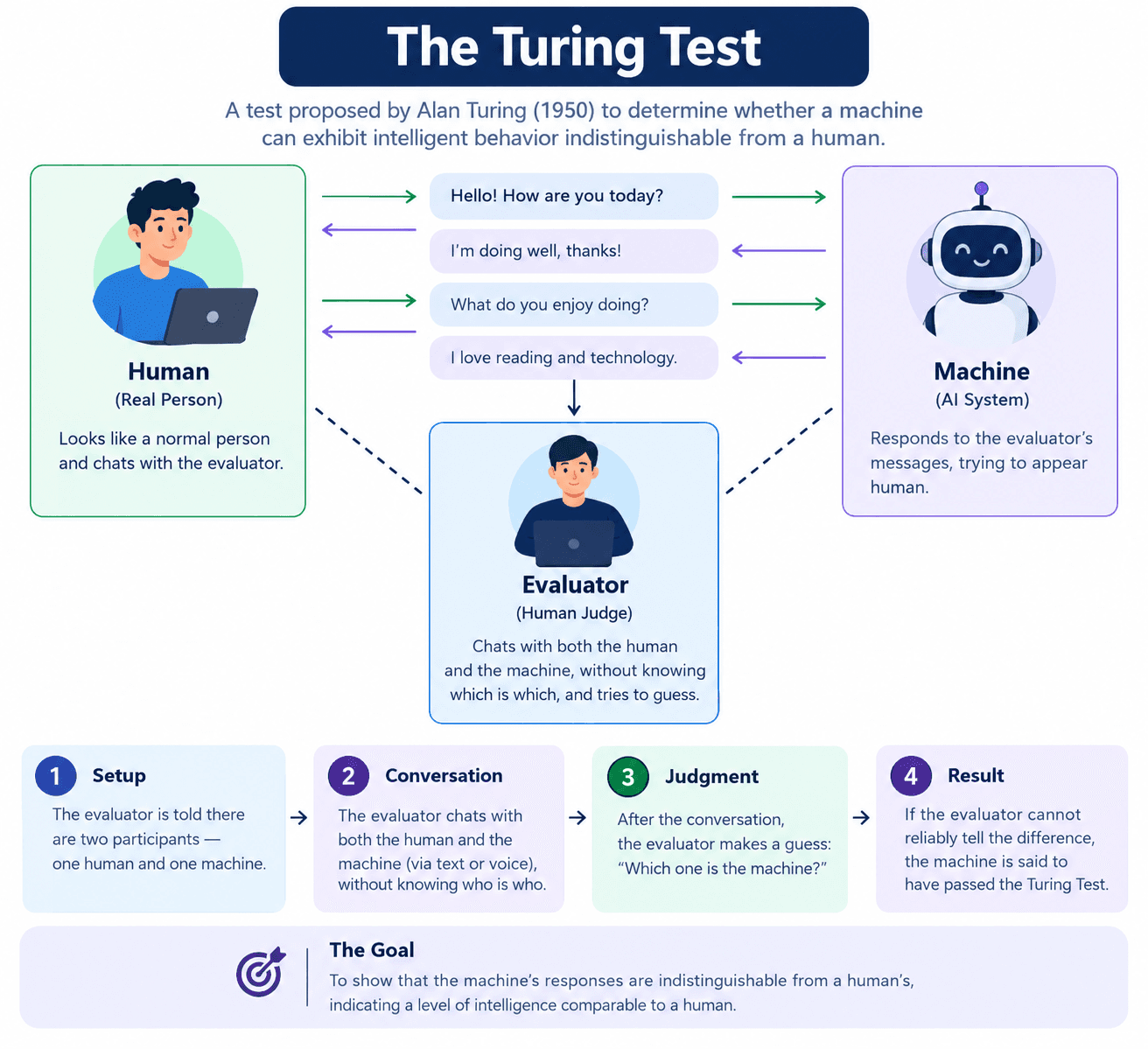
How the Turing Test Works:
- An Evaluator (or Judge) chats/asks questions with two hidden participants: one human, and one machine.
- The Evaluator asks questions and decides who is the human.
- If the Evaluator can't reliably tell the machine from the human, the machine PASSES the Turing test.
- It passes if it can imitate human-like responses. The focus is on indistinguishable behavior, not internal thinking. It's about conversations, not just solving math or facts.
The Coining of "AI" and The AI Winter
Even though Turing laid the groundwork in 1950, the term "Artificial Intelligence" was not coined then.
- 1955: John McCarthy (Computer Engineer) used the name "Artificial Intelligence" for the first time. Research came together with a unified ambition: "Every aspect of learning and intelligence could, in principle, be described precisely enough for a machine to simulate it."
- The AI Winter (Before 1986): History wasn't a straight line; it was a roller coaster. Hype increased and decreased multiple times. We hit an "AI Winter" where there was no AI hype, no investments, and research slowed down due to early failures in making machines intelligent.
(Note: During this time, concepts like "Synthetic Intelligence" were also explored, differentiating between simulated intelligence AI and genuine machine intelligence capable of independent reasoning and awareness).
The Era of Rule-Based AI (1950 - 1980s)
Before modern AI, we relied on Rule-Based AI, also called Expert Systems. Intelligence was simply a collection of rules built by human experts.
Machines made decisions based on 100s of "If/Else" rules:
- Example 1 (Spam Detection):
If ("FREE" OR "$$$" OR "LOTTERY") -> SPAM - Example 2 (Medical):
If (Fever && Cold && BodyAche) -> FLU
The 1997 Milestone: Deep Blue
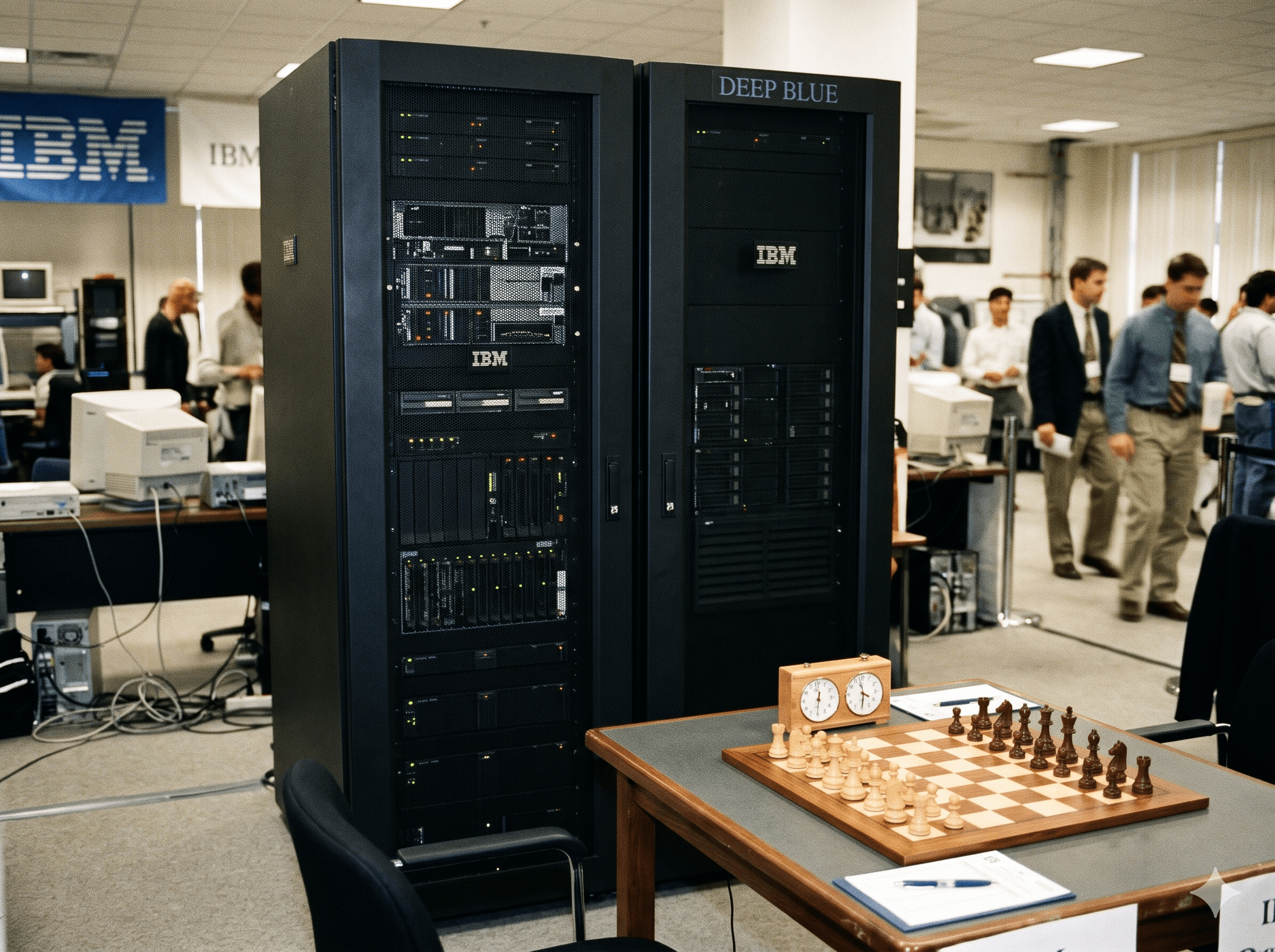
In 1997, IBM developed Deep Blue, a system that played chess and famously defeated Garry Kasparov, the world's best chess player at the time. This led to news headlines asking: "Have machines become smarter than humans?"
However, Deep Blue was not true AI by today's standards. It was a rule-based system designed on permutations and combinations to calculate the best possible move in chess. We needed a new approach to truly replicate human intelligence.
Up Next: Recommended For You
Readers who finished this note also explored these next: